
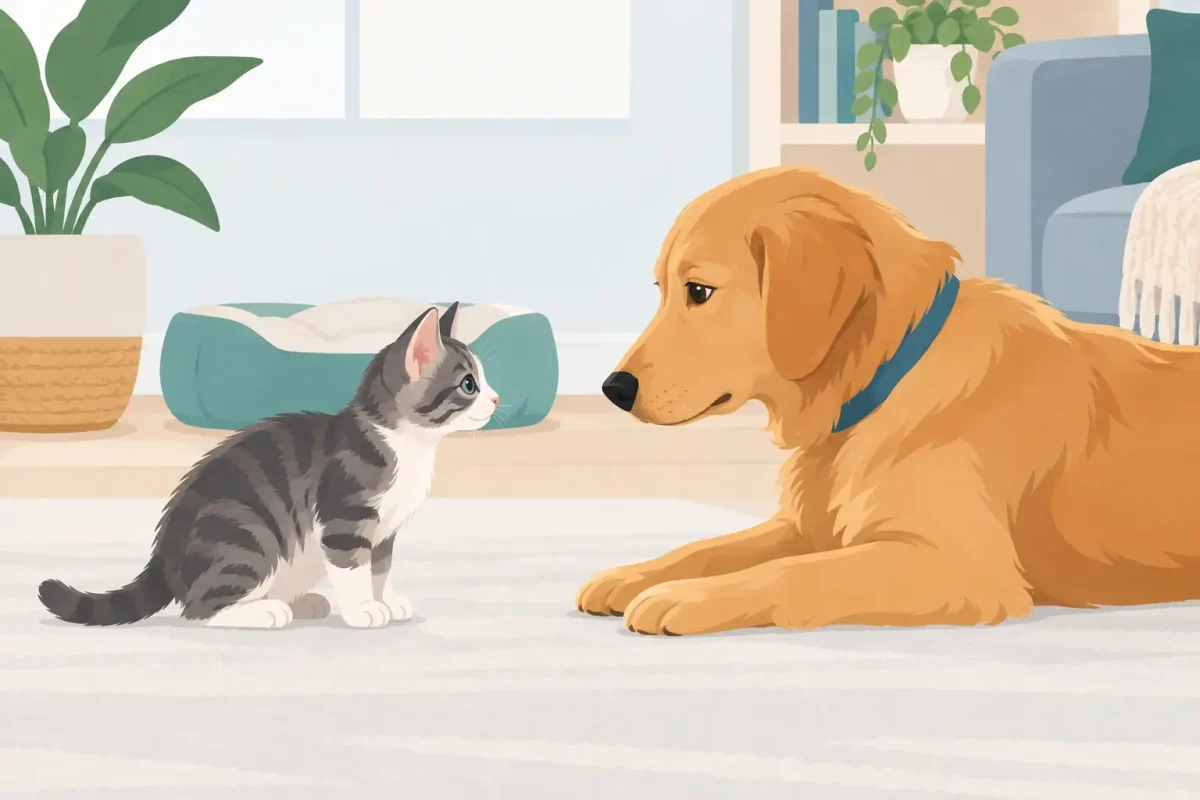
The first few minutes your new kitten and dog spend near each other can shape the feeling of the whole first week. A thoughtful kitten dog introduction is not about making them become friends immediately. It is about helping each pet feel safe enough to stay curious, calm, and in control of their own space.
For families bringing home a Maine Coon or Ragdoll kitten, this slow beginning is especially worthwhile. These affectionate, people-oriented breeds often settle beautifully into loving homes, but every kitten is still small, new to the environment, and learning the personality of the dog who was there first. Patience protects that confident, well-loved kitten spirit you have been waiting for.
Start Before Your Kitten Comes Home
A successful introduction starts with preparation, not a face-to-face meeting at the front door. Set up one quiet room as your kitten’s home base. It should have food and water placed apart from the litter box, a soft bed, a scratching surface, hiding spots, and a few familiar toys. This room gives your kitten a place where the dog cannot follow and where daily routines can begin without pressure.
If possible, begin refreshing your dog’s basic cues before pickup day. A reliable response to sit, stay, leave it, and come is helpful, not because your dog needs to perform perfectly, but because you need a calm way to redirect attention. A dog that can settle on a mat or bed while good things happen nearby will have an easier time than a dog expected to resist excitement without guidance.
It also helps to think honestly about your dog’s usual behavior around small animals. A friendly dog may still be overly eager. A shy dog may bark from uncertainty. A dog with a strong chase instinct needs much more management, and in some cases, a veterinarian, credentialed trainer, or behavior professional should be part of the plan before direct contact occurs. Loving both pets means recognizing when careful boundaries are needed.
The First Days of a Kitten Dog Introduction
Bring your kitten directly to the prepared room in a secure carrier. Let them come out when they are ready. Some kittens investigate right away, while others need several quiet hours or a day or two before they feel comfortable. Keep the dog away from the door at first, even if the dog seems gentle and eager to say hello.
During this time, let the pets become aware of each other through scent and sound. You can exchange a small blanket or gently rub each pet with a clean cloth and place it near the other pet’s resting area. Give treats or a meal while they smell the unfamiliar scent, creating a simple association: this new presence predicts something pleasant.
A closed door is not a setback. It is a useful stage. Your kitten can learn that the dog exists without feeling trapped, while your dog learns that calm behavior around the kitten’s room earns praise and attention. If your dog scratches, barks, whines intensely, or fixates on the door, increase the distance and work on settling elsewhere. Do not scold either pet for being worried. Quiet management and a slower pace work better.
After both animals are comfortable with the closed-door routine, allow brief visual contact through a sturdy baby gate, a cracked door secured with a doorstop, or another safe barrier. Keep the dog on a leash and give the kitten a clear route back to their safe room. The kitten should never be held up for the dog to inspect. Being unable to retreat can turn natural caution into fear.
Keep these sessions short. A calm look, a sniff, and a treat can be enough for the day. End while both animals are still composed rather than waiting for tension to build.
Read What Each Pet Is Telling You
Dogs and kittens do not need to look delighted to be making progress. Neutral, relaxed behavior is a very good sign. Your dog may glance at the kitten and then look back at you. Your kitten may watch from a perch, groom, eat, or choose to walk away. These are signs that neither animal feels forced into a confrontation.
Watch for signals that say the pace is too fast. In a dog, concern can look like a hard stare, stiff body, closed mouth, repeated lunging, intense whining, or inability to disengage from the kitten. In a kitten, look for flattened ears, a puffed tail, hissing that escalates, crouching, hiding for long periods, or refusing food after interactions. One brief hiss is normal communication, especially in a new home. Repeated distress means it is time to return to the previous step.
It is tempting to interpret a wagging tail as automatic friendliness, but context matters. A loose, wiggly dog who can turn away is different from a dog standing tall and staring with a high, stiff tail. Likewise, a brave kitten may approach a dog quickly, but confidence does not make a small kitten physically safe around an excitable dog. Supervision remains essential even when the meeting looks promising.
Move to Short, Supervised Time Together
When barrier meetings remain calm over several sessions, you can try brief time in the same room. Start after your dog has had appropriate exercise and a chance to settle, not during the most energetic part of the day. Keep the dog on a loose leash, and choose a room where the kitten has access to elevated spaces and an open exit.
Give your dog something calm to do, such as resting on a mat with a chew or receiving small treats for looking away from the kitten. Let the kitten decide whether to explore. Do not coax them toward one another or ask the dog to tolerate a kitten climbing on them. Respecting space now prevents uncomfortable reactions later.
For the first several weeks, separate them whenever no attentive adult is available. This includes nighttime, errands, school runs, and busy moments when the household cannot closely observe body language. Use doors, gates, crates as appropriate for the dog, and the kitten’s safe room. Management is not failure. It is how trust has time to grow without a frightening incident.
Make the Home Work for Both Pets
A kitten needs resources the dog cannot crowd. Keep litter boxes in dog-free areas, since many dogs are drawn to them. Feed your kitten where they can eat without being watched, and provide cat trees, window perches, or shelving that allow vertical distance. High spaces are not just fun for a Maine Coon or Ragdoll kitten. They offer a safe place to observe family life at a comfortable distance.
Continue giving your dog individual attention. A new kitten changes the household rhythm, and dogs can become restless if walks, play, and quiet time suddenly disappear. Predictable routines help the resident dog feel secure and reduce the chance that the kitten becomes the focus of excess energy.
For kittens, keep handling gentle and brief at first, especially after a session with the dog. Many kittens benefit from a familiar rhythm of meals, play, rest, and calm affection. At Maine Coon And Ragdoll House, we see how much steady household exposure and kind daily handling can support a kitten’s confidence, but a new home is still a big transition. Give your kitten time to learn its new family one safe experience at a time.
When Friendship Takes Longer Than Expected
Some kitten and dog pairs share a room peacefully within days. Others need weeks, and a few may always do best with respectful distance rather than close companionship. The goal is not matching social media images of pets sleeping in a pile. The goal is a home where both animals can rest, eat, play, and move around without fear.
If tension grows instead of easing, pause direct interactions and return to scent and barrier work. Reach out to your veterinarian if either pet stops eating, begins eliminating outside the litter box, seems unusually withdrawn, or shows sudden behavior changes. For chasing, snapping, or persistent fixation, seek qualified behavior guidance promptly rather than hoping the pets will work it out themselves.
The sweetest introductions are often quiet ones: your dog chooses to settle while the kitten explores, your kitten naps on a perch while the dog passes by, and both pets learn that the other belongs. Give them that unhurried beginning, and their relationship has room to become something wonderfully familiar.
