
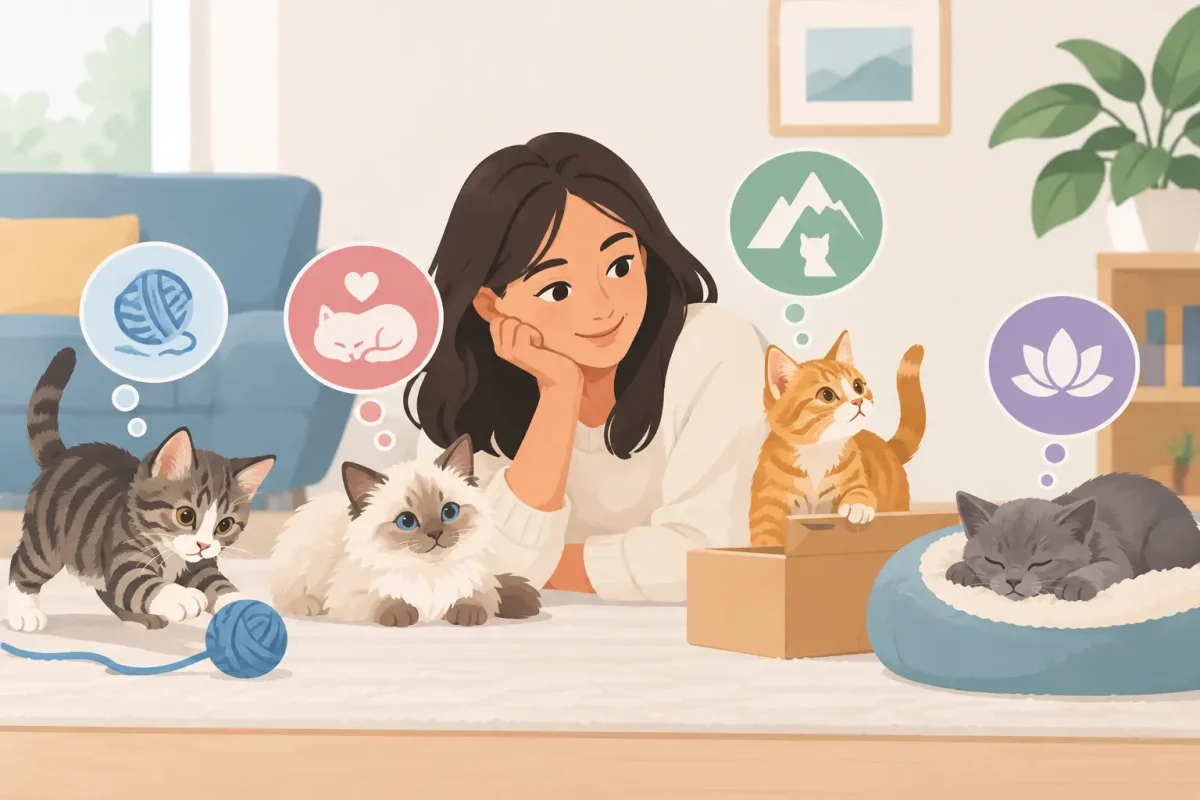
The kitten who climbs into your lap may be irresistible, but that one sweet moment is only part of the picture. Learning how to choose kitten personality means looking past color, gender, and a single playful visit to consider how a kitten’s natural energy, confidence, affection, and social needs will fit into your everyday life. The right match feels less like choosing the prettiest face and more like welcoming a well-loved little family member whose presence brings calm joy for years to come.
A kitten’s personality is shaped by both nature and nurture. Breed tendencies, planned pairings, early handling, household exposure, and each kitten’s individual character all play a role. No responsible breeder can promise that every adult behavior is predetermined, but careful observation during the first weeks gives families meaningful clues.
Start With Your Household, Not the Kitten’s Color
Before asking which kitten is available, think honestly about the rhythm of your home. A quiet couple working from home may enjoy a socially involved kitten who likes to follow people from room to room. A busy family with children may need a confident, patient kitten that recovers quickly from normal household noise and activity. A home with a resident cat or gentle dog needs a kitten with a flexible, curious nature and a thoughtful introduction plan.
There is no universally “best” personality. A lively kitten can be a wonderful choice for an active household that enjoys interactive play. That same kitten may feel overwhelming in a home hoping for a more settled companion. Likewise, a soft-spoken, observant kitten may thrive with a patient owner but may take longer to warm up in a busy environment.
It also helps to consider how much time you will realistically spend at home. Kittens are social, playful, and still learning about their world. If everyone is gone for long workdays, a kitten may benefit from another compatible feline companion, extra enrichment, and a predictable routine. If you work remotely, a people-oriented kitten may happily make itself part of every meeting and coffee break.
How to Choose Kitten Personality by Watching Behavior
A kitten does not need to be the boldest in the litter to become an affectionate, secure adult. In fact, the kitten rushing forward first may simply be more food-motivated or more curious at that moment. Look for patterns over time rather than placing too much meaning on one visit or one photograph.
A confident kitten often explores a new toy, recovers after an unexpected sound, and returns to play after a short pause. A cuddly kitten may seek out people, relax when gently held, purr readily, or settle nearby after playtime. A more independent kitten may prefer to investigate first and approach affection on its own terms. Independence is not a flaw – it can be a lovely fit for someone who appreciates a companion with a little personal space.
Ask how the kitten behaves during ordinary parts of the day. Does the kitten enjoy being picked up? How does it respond to gentle brushing, nail handling, or being carried briefly from one room to another? Is it curious around visitors, children, vacuum sounds, and other pets? Does it play enthusiastically, then settle well afterward?
These everyday details matter because they reflect the kind of experiences a kitten has had in the home. A kitten raised with steady handling and normal household activity is learning that people, routines, and gentle care are safe.
Know the Maine Coon and Ragdoll Temperament Differences
Breed characteristics can help you begin the matching process, but they should never replace getting to know the individual kitten. Maine Coons and Ragdolls are both cherished for their affectionate, family-friendly nature, yet they often express their companionship differently.
Maine Coon kittens often bring playful companionship
Maine Coons are frequently described as sociable, curious, and entertaining. Many enjoy staying involved in household activity, following their people, watching from a favorite perch, and joining in interactive games. Their playful side can last well beyond kittenhood, so they often suit families who want a big-hearted cat with an engaged, slightly mischievous spirit.
That said, Maine Coons are not all high-energy all the time. Some are calm observers, while others are busy little adventurers. Their large size also means early comfort with handling and grooming is especially helpful. A Maine Coon kitten who accepts regular brushing and enjoys gentle interaction can be easier to care for as that fluffy coat and substantial frame mature.
Ragdoll kittens often offer gentle closeness
Ragdolls are widely loved for their soft, people-focused personalities. Many form close bonds with their families and enjoy quiet company, lap time, and being near the center of home life. They can be a beautiful fit for people seeking a gentle companion who brings comfort without demanding constant activity.
Still, Ragdolls are kittens first. They play, chase, climb, and have bursts of silly energy. A calmer breed tendency does not mean a kitten will be inactive. The goal is to choose a kitten whose individual confidence and sociability match your household, while appreciating the affectionate, easygoing qualities the breed is known for.
Ask Your Breeder Better Questions
The breeder who lives with the kittens every day sees things a short visit cannot reveal. They know who settles into a lap after breakfast, who starts the wrestling matches, who is first to investigate a new room, and who prefers to watch before joining in. Open, detailed communication is one of the most valuable parts of choosing a kitten from a family-raised program.
Rather than asking only, “Which one is the friendliest?” try sharing what life looks like in your home. Explain whether you have young children, other pets, frequent guests, quiet evenings, or a work-from-home schedule. Mention whether you hope for a lap cat, an interactive playmate, a confident companion for a dog, or a kitten that can grow comfortably with a first-time cat owner.
Then ask which kitten the breeder feels is the most natural fit and why. Useful questions include whether a kitten seeks human attention, how it handles routine care, whether it is easygoing around its littermates, and how it responds after a new experience. A thoughtful breeder will be honest about each kitten’s stage of development and avoid making exaggerated guarantees.
At Maine Coon And Ragdoll House, that individual observation is part of the matching process. Kittens are raised in a home setting, where their personalities can be seen in ordinary moments, not just in a staged photo or a brief first meeting.
Consider Age and the Limits of Early Predictions
A young kitten’s personality is still developing. At an early age, even a confident kitten can have a shy afternoon, and even a quiet kitten can become the star of a play session. Developmental stages, growth spurts, new skills, and litter dynamics all influence behavior.
This does not make early observations meaningless. It simply means they should be interpreted with care. Repeated behavior is more revealing than a single reaction. A kitten who consistently seeks people, recovers well from change, and handles gentle touch comfortably is showing a useful pattern. A kitten who prefers a slower approach may still become deeply devoted once trust is established.
Families should also remember that transition day can temporarily change behavior. A kitten leaving its mother, littermates, and familiar routines may be quiet, clingy, or hesitant during the first few days at home. That is normal adjustment, not proof that you chose the wrong personality.
Make Room for the Kitten to Become Themselves
The best personality match still needs the right environment to flourish. Prepare one calm room or area with food, water, a litter box, a cozy bed, scratching options, and safe toys. Let the kitten set the pace for exploring. Gentle play, regular meals, quiet conversation, and predictable rest periods build trust far better than constant handling or introductions all at once.
For homes with children, teach everyone that affection should be invited, not forced. Sitting nearby with a toy is often more successful than reaching for a nervous kitten. For multi-pet homes, slow introductions protect confidence and give every animal time to adjust. A kitten who seems reserved on day one may become wonderfully outgoing once they know the home is safe.
Choosing a kitten is a tender decision, and it is okay to take your time. Share your hopes honestly, listen to the breeder who knows the litter well, and leave room for the small surprises that make each cat an individual. The right kitten is not simply the one who looks perfect in a photo – it is the one whose little personality feels at home with yours.
